I had a cooperative Hairy and Downy Woodpecker on the suet log the other day and snapped a few photos. I've learned if you have the opportunity to show them side-by-side you do it. So many people haven't seen them next to each other to get an idea of size comparison.
Hairys have a wide range of length: from 8-12." Downys on the other hand, rarely venture outside the 5.5-6.5" length.
In addition to the overall size of the bird, you can look for these two identifying features:
1) beak length. A Hairy Woodpecker's beak will be nearly the depth of its head. It's very balanced in appearance. On the other hand, the Downy Woodpecker's thin, tiny bill looks small on its face; typically measures half of its head depth. I like to think that the Downy's beak looks like a little ice pick whereas the Hairy's beak is more like a true woodpecker's beak.
2) bars or spots on tail feathers. Here in Minnesota (and the Eastern part of the U.S.), Downy Woodpeckers have black dots on outer white tail feathers; Hairy Woodpeckers have solid white feathers. Oddly, in Newfoundland and in the Pacific Northwest (wouldn't you think they'd be closer geographically?), Hairy Woodpeckers often have the black tail markings of Downy Woodpeckers.
Wednesday, April 20, 2011
Saturday, April 16, 2011
Spring Blooms...and snow
Just a few days ago this is what greeted me one morning:
This morning, it's a different sight. The pasque and crocus are completely buried under 2" of fresh spring snow:
I'm holding out hope that our forsythia will still open. Only once in the last 9 years have we lost the blooms due to cold weather, and that was on April 9, 2006.
The bright yellow of a male goldfinch is a welcome splash of color:
Even the deer came out to check out a downed tree:
This morning, it's a different sight. The pasque and crocus are completely buried under 2" of fresh spring snow:
I'm holding out hope that our forsythia will still open. Only once in the last 9 years have we lost the blooms due to cold weather, and that was on April 9, 2006.
The bright yellow of a male goldfinch is a welcome splash of color:
Even the deer came out to check out a downed tree:
Friday, April 8, 2011
Cricket Radio
Here in the frozen tundra of Minnesota, spring is slowly emerging. Tulips have broken through, crocuses and squills are blooming and, if you're quiet at night, you can hear the first frogs beginning to call.
For me, nothing speaks more of the northwoods and summer than the lively chorus of frogs, toads, crickets and other night insects.
Several weeks ago I enjoyed listening to an NPR broadcast focusing on all these sounds with guest author John Himmelman.
Himmelman's written a book titled "Cricket Radio" about the night's "nature sounds" and what prompts these critters to produce them.
The sounds swept me away with the promise of warm summer nights. Himmelman's voice detailing what I was hearing, and why I was hearing it, was perfect.
Here's the "Cricket Radio" site where you can listen to the NPR program and learn more about Himmelman's book.
For me, nothing speaks more of the northwoods and summer than the lively chorus of frogs, toads, crickets and other night insects.
Several weeks ago I enjoyed listening to an NPR broadcast focusing on all these sounds with guest author John Himmelman.
Himmelman's written a book titled "Cricket Radio" about the night's "nature sounds" and what prompts these critters to produce them.
The sounds swept me away with the promise of warm summer nights. Himmelman's voice detailing what I was hearing, and why I was hearing it, was perfect.
Here's the "Cricket Radio" site where you can listen to the NPR program and learn more about Himmelman's book.
Tuesday, April 5, 2011
Midwest Crane Count
Gather around Citizen Scientists:
The annual Midwest Crane Count is next Saturday, April 16.
Join more than 3,000 other volunteers as we record crane counts in six Midwest states: Minnesota, Wisconsin, Michigan, Illinois, Iowa and Indiana.
To volunteer, just contact your county coordinator.
And, this morning on WPR at 11am (during Larry Meiler's show time) staff from the International Crane Foundation in Baraboo, Wis., will talk about the upcoming count and how crane populations are doing here in the U.S. and around the world. Should be a fascinating program!
(for those not familiar w/WPR's online stream, follow the link and then choose the "Ideas Network" streams.)
Many thanks to WRC for the use of the juvenile Sandhill Crane photo.
Archived WPR stream (2nd one down, 11am on Tuesday, April 5)
The annual Midwest Crane Count is next Saturday, April 16.
Join more than 3,000 other volunteers as we record crane counts in six Midwest states: Minnesota, Wisconsin, Michigan, Illinois, Iowa and Indiana.
To volunteer, just contact your county coordinator.
And, this morning on WPR at 11am (during Larry Meiler's show time) staff from the International Crane Foundation in Baraboo, Wis., will talk about the upcoming count and how crane populations are doing here in the U.S. and around the world. Should be a fascinating program!
(for those not familiar w/WPR's online stream, follow the link and then choose the "Ideas Network" streams.)
Many thanks to WRC for the use of the juvenile Sandhill Crane photo.
Archived WPR stream (2nd one down, 11am on Tuesday, April 5)
Friday, April 1, 2011
Friday Coffeebreak
I haven't been to this site in a while, but the travel bug was biting so it's the perfect Friday coffeebreak:
NASA Astronaut photo quiz
Thanks, NASA!
Tuesday, March 29, 2011
At The Scene Of The Crime
Earlier this morning I noticed something flopping around on the edge of our yard. Turns out it was a sub-adult Cooper's Hawk with a catch.
It flew to our Norway Spruce to avoid the marauding crows and stayed there for over an hour. It took more than 15 minutes for it to consume its breakfast and then it simply hunkered down and enjoyed the rest of the morning.
Surprised that it'd take 15 minutes to devour a tiny junco or chickadee, I did what any good investigator would do. I went to the scene of the crime:
Alas, turns out breakfast was a cardinal. A pretty nice size meal in all honesty! Although why it couldn't take one of the dozen starlings that have been hanging around... starlings must not be tasty.
If you take a wider look at the scene, you can see the hawk actually struggled to pin the cardinal (must've been what all the flopping was about):
During the investigation I checked out the spruce where it had been sitting. It left behind a nice poofy nest of feathers on top of a mat of boughs, and these soft little ones clinging to the end of a branch. All that remains of a cardinal...
It flew to our Norway Spruce to avoid the marauding crows and stayed there for over an hour. It took more than 15 minutes for it to consume its breakfast and then it simply hunkered down and enjoyed the rest of the morning.
Surprised that it'd take 15 minutes to devour a tiny junco or chickadee, I did what any good investigator would do. I went to the scene of the crime:
Alas, turns out breakfast was a cardinal. A pretty nice size meal in all honesty! Although why it couldn't take one of the dozen starlings that have been hanging around... starlings must not be tasty.
If you take a wider look at the scene, you can see the hawk actually struggled to pin the cardinal (must've been what all the flopping was about):
During the investigation I checked out the spruce where it had been sitting. It left behind a nice poofy nest of feathers on top of a mat of boughs, and these soft little ones clinging to the end of a branch. All that remains of a cardinal...
Thursday, March 24, 2011
Is it Christmas?
Some things just have to be shared immediately.
After a long day I arrived home to Mtn. Man excitedly pointing to our Red Pine. A casual look for birds presented nothing super interesting, which probably revealed how frazzled I was from work.
Because a second glance showed what he was all giddy about:
The tree is decorated like a Christmas tree with hundreds of glittering icicles hanging off it. Some are more than 8" long, it's breathtaking. What a simple but awe-inspiring sight. If you could see it in person you'd be amazed, it just glimmers. (Unfortunately my photography skills don't capture the beauty - how do you capture those sparkly glints? They just appear white in the photos... Sigh. You'll have to imagine thousands of glittery sparkles hanging off the tree.)
So I step outside, smell the spring air and absorb nature. Internal balance is restored.
After a long day I arrived home to Mtn. Man excitedly pointing to our Red Pine. A casual look for birds presented nothing super interesting, which probably revealed how frazzled I was from work.
Because a second glance showed what he was all giddy about:
The tree is decorated like a Christmas tree with hundreds of glittering icicles hanging off it. Some are more than 8" long, it's breathtaking. What a simple but awe-inspiring sight. If you could see it in person you'd be amazed, it just glimmers. (Unfortunately my photography skills don't capture the beauty - how do you capture those sparkly glints? They just appear white in the photos... Sigh. You'll have to imagine thousands of glittery sparkles hanging off the tree.)
So I step outside, smell the spring air and absorb nature. Internal balance is restored.
Peppers to Warm a Cold Winter's Night
Oh, the lovely taste of freshly picked spicy peppers! Is there anything better than fresh vegetables? Especially in the winter.
Last night we stuffed and enjoyed 5 of our famous non-Gypsy peppers. They're smaller than usual, but their flavor was incredible!
We refer to them as non-Gypsies because the tiny plant was labeled a Gypsy pepper plant when we bought it two summers ago. After it bore fruit we realized it was in fact, NOT a Gypsy but our local greenhouse is seasonal and was already closed by then. They taste like a cross between a Serrano and a bell, but they're not Hungarian peppers. (we have those overwintering downstairs) So far, we've had no luck identifying them.
All in all, we've harvested peppers from all four plants this winter: Serrano, Hungarian Hot, tiny little Asian chilis and the non-Gypsy.
And, awhile back (on the solstice to be precise), I mentioned that we had started a few Roma tomatoes from seed and that they'd sprouted. I really wasn't sure what to expect, we're growing them without grow lights, but I'm happy to say that they've developed the first tiny little tomatoes!
The plants themselves aren't very strong. I discovered that people recommend directing a fan to blow on larger stemmed plants a few times a day as they're growing to help them develop a strong base. Note for next year!
Even if we don't pick tomatoes until May, it'll still be months ahead of our usual garden schedule. I can't wait for fresh tomatoes. Not only that, but psychologically it's great to have fresh green vegetable plants around while we're chomping at the bit for true spring to arrive.
Wednesday, March 23, 2011
Black and White with a Splash
This morning, as I glanced out at the gorgeous spring snowscape, it dawned on me that although the yard is filled with shades of black and white, the various shades and tones are quite striking.
Just consider the winter birds: chickadees, juncos, all the woodpeckers, shrikes and yes, the ever-present starlings: they're all black and white combinations. Even the finches are typically in their drab winter colors, now with just a touch of bright yellow flashing every now and then.
The red splashes of color found on woodpeckers and house finches seem to stand out all the more for the otherwise duotone landscape. The brilliant splash of a blue jay or cardinal, and the red breast of a robin, really adds an exclamation mark.
The flock of house finches that arrived last week looks like Christmas ornaments hung in the snowy trees today. Just bits of bright red scattered throughout:
And, below the feeders this morning, mixed in with the "usual suspects" was our first song sparrow of the year (far left):
Just consider the winter birds: chickadees, juncos, all the woodpeckers, shrikes and yes, the ever-present starlings: they're all black and white combinations. Even the finches are typically in their drab winter colors, now with just a touch of bright yellow flashing every now and then.
The red splashes of color found on woodpeckers and house finches seem to stand out all the more for the otherwise duotone landscape. The brilliant splash of a blue jay or cardinal, and the red breast of a robin, really adds an exclamation mark.
The flock of house finches that arrived last week looks like Christmas ornaments hung in the snowy trees today. Just bits of bright red scattered throughout:
And, below the feeders this morning, mixed in with the "usual suspects" was our first song sparrow of the year (far left):
Friday, March 18, 2011
Springs Signs and Spiders
Yesterday I was greeted with exploding buds on our popular trees at WRC.
Today, I checked our front garden bed, and sure enough: tulips! Looks like they must have poked up last weekend, they're already a couple inches tall.
The front bed faces south and the heat reflects off the white house, creating an especially warm bed. We've found it's almost a zone warmer and have been able to grow lavender and other perennials that aren't traditionally hardy in Minnesota winters.
And, last week in the Florida recap I mentioned to check back for news on the starfish ID and a funny look at spider phobia. Being a newbie blogger I was lax in following through on my promise. Thanks for the emails reminding me!
So, to answer the starfish question - no I've not been able to ID it, very frustrating, it should be easy (or so it seems to my mind). It'll remain on my to-do list.
For a hilarious story about spiders (topic came up while attempting research on crab IDs), turn to Hyperbole and a Half: a very amusing blog with incredibly simple but effective sketches. The"Spiders Are Scary" post captures the hysteria (and hysterical) aspects of hunting a spider in your house. And, for dog lovers, her "Dog" post, followed by "Dogs Don't Understand..." will have you rolling. Sadly, our 1.5 year-old "puppy" now responds to his new name: "Simple Dog."
So there you are. Signs of Springs and Fun Friday posts on spiders and dogs!
Today, I checked our front garden bed, and sure enough: tulips! Looks like they must have poked up last weekend, they're already a couple inches tall.
The front bed faces south and the heat reflects off the white house, creating an especially warm bed. We've found it's almost a zone warmer and have been able to grow lavender and other perennials that aren't traditionally hardy in Minnesota winters.
And, last week in the Florida recap I mentioned to check back for news on the starfish ID and a funny look at spider phobia. Being a newbie blogger I was lax in following through on my promise. Thanks for the emails reminding me!
So, to answer the starfish question - no I've not been able to ID it, very frustrating, it should be easy (or so it seems to my mind). It'll remain on my to-do list.
For a hilarious story about spiders (topic came up while attempting research on crab IDs), turn to Hyperbole and a Half: a very amusing blog with incredibly simple but effective sketches. The"Spiders Are Scary" post captures the hysteria (and hysterical) aspects of hunting a spider in your house. And, for dog lovers, her "Dog" post, followed by "Dogs Don't Understand..." will have you rolling. Sadly, our 1.5 year-old "puppy" now responds to his new name: "Simple Dog."
So there you are. Signs of Springs and Fun Friday posts on spiders and dogs!
Tuesday, March 15, 2011
An Evening Surprise: Waxwings!
Just 20 minutes ago I looked out our east window to see a bird high up in the trees with a yellow bar across its tail. It flew west, with us running through the house to follow it, where it quickly disappeared into our White Oak.
Assuming it was a waxwing, and knowing they move in flocks, we started looking for the birds. Apparently oak leaves are the perfect camouflage for Cedar Waxwings. Just look:
In this photo there are seven birds (the 7th is tucked behind the other birds, you can just see its brown feathers). I snapped this photo to show how they blend in with the leaves, it seems they even mirror the shape. All in all, we counted a flock of at least 20, but there are probably more birds tucked away in the leaves. We learned quickly to look either for the bright red dots or the straight yellow tail bar.
Here's a shot showing the red wing spots:
Wondering if they'll roost there over night or if they're just using it as a resting spot... What a nice spring surprise!
Assuming it was a waxwing, and knowing they move in flocks, we started looking for the birds. Apparently oak leaves are the perfect camouflage for Cedar Waxwings. Just look:
In this photo there are seven birds (the 7th is tucked behind the other birds, you can just see its brown feathers). I snapped this photo to show how they blend in with the leaves, it seems they even mirror the shape. All in all, we counted a flock of at least 20, but there are probably more birds tucked away in the leaves. We learned quickly to look either for the bright red dots or the straight yellow tail bar.
Here's a shot showing the red wing spots:
Wondering if they'll roost there over night or if they're just using it as a resting spot... What a nice spring surprise!
Monday, March 14, 2011
WPT's Documentary: "Our Birds" (updated)
This morning on my way in to WRC, I was listening to WPR (I lose it near the 3M building) and they were talking about a fascinating new documentary on WPT called "Our Birds."
It's a look at birds found in Wisconsin (like the Palm Warbler shown here) and where they spend the majority of the year: Central and South America. It examines the challenges they face not only here in the Midwest, but also the tolls of migration and the disappearing home territories of these birds. Since many "Wisconsin" birds are also "Minnesota" birds, I thought this might be of interest to people.
More than 200 of our birds spend the majority of their life south of the border. As one of the guests said, if they spoke a language, it'd be Spanish, not English.
The program debuts this Thursday at 7pm. A sneak peek and more info is available at WPT and I'll link WPR's archives of today's show when it's posted tomorrow morning.
Update: here's WPR's archived stream, 2nd one down on the page (11am).
A Costa-Rican paper picked up Warren Gerds' column on the documentary this morning.
And, I should've mentioned that yes, WPT will stream the program at 7pm (and it'll be archived) so we can all enjoy. Here's the program's site where they'll be streaming it.
It's a look at birds found in Wisconsin (like the Palm Warbler shown here) and where they spend the majority of the year: Central and South America. It examines the challenges they face not only here in the Midwest, but also the tolls of migration and the disappearing home territories of these birds. Since many "Wisconsin" birds are also "Minnesota" birds, I thought this might be of interest to people.
More than 200 of our birds spend the majority of their life south of the border. As one of the guests said, if they spoke a language, it'd be Spanish, not English.
The program debuts this Thursday at 7pm. A sneak peek and more info is available at WPT and I'll link WPR's archives of today's show when it's posted tomorrow morning.
Watch the full episode. See more In Wisconsin.
Update: here's WPR's archived stream, 2nd one down on the page (11am).
A Costa-Rican paper picked up Warren Gerds' column on the documentary this morning.
And, I should've mentioned that yes, WPT will stream the program at 7pm (and it'll be archived) so we can all enjoy. Here's the program's site where they'll be streaming it.
Wednesday, March 9, 2011
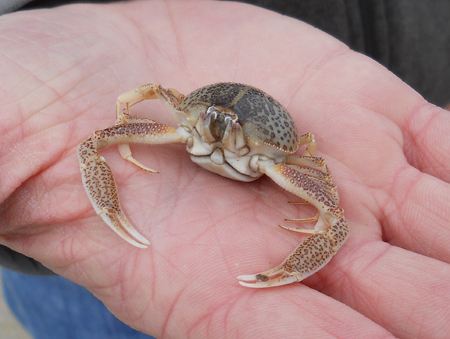
I finally sat down this morning to do a quick recap of our recent Florida trip. I had about an hour before a meeting and I figured it wouldn't be hard at all. The only thing I needed to research before writing it, was the identity of this cute little crab we found on a St. Augustine beach:
One hour of research later, and 6 hours from my initial attempt to post, I'm happy to say that the crab is either a Mottled Sponge Purse Crab or just a Mottled Purse Crab. I gave up on Google trying to discover the difference between the two.
And, speaking of Googling crabs, let me just state what might be fairly obvious, but I hadn't thought of: 1) adding "salt water" to the search helps get rid of results on crabs you don't want to know about (yikies!) and 2) there are apparently quite a few "spider" crabs out there - both crabs that look like spiders, and spiders that are called crabs. For someone terrified of spiders, this is not a pleasant search. (check back Friday for fun spider phobia post)
On that same beach we found dozens of these red starfish. They ranged in size from 1.5" across to 6." And no, I've not tried Googling its identity yet.
After 2 days of St. Augustine we experienced one of the highlights of our trip: the Discovery launch.
What an amazing experience! I'd never attended a launch before, we actually just happened to be over in the area and drove down that day, much to the amazement of nearly everyone we talked to in Titusville, many of whom had camped out for weeks during the initial launch period, and had attempted to see several other shuttle launches, only to have them postponed. Apparently we are quite fortunate to have seen a launch on our first try.
Being outdoorsy people, we spent every day on or near the water. We stayed in Crystal River, which is aptly named "The Nature Coast." We kayaked several times, fished in the Gulf (caught Spanish mackerel and spotted sea trout), shelled at Caladesi Island and enjoyed watching the manatees, dolphins, otters and other critters off our tidal river dock.
The Atlantic Coast is quite different from the Gulf, and the coastal Gulf areas are very different than the coastal tidal areas. It was fascinating to see three different habitats and have a chance to explore them all.
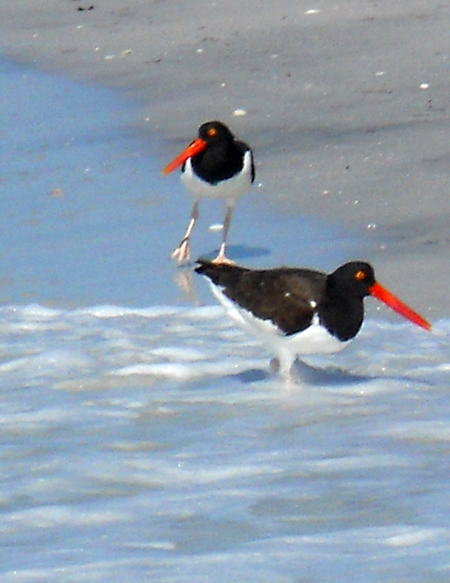
I tried to snap some photos of the American Oystercatchers on Caladesi, but we just had our cheap snappy camera with us and it didn't grab the focus very well. I love how cartoonish the bird's appearance is and watching them pull up the little "butterfly" clams between the incoming waves is great fun.
Other bird highlights included Little Blue Herons, Tricolored Herons and my first glimpse of immature White Ibises - I had no idea they were brown!
Wish the photo had turned out better, but managing a camera while kayaking on coastal waters is a skill I've yet to develop. (note to oneself: spend more time kayaking!)
The other really cool bird experience was watching a cormorant try to manage a very large fish. It actually speared the fish through the gills with its upper and lower bill.
Check back Friday for an ID on the starfish and more about spider phobias!

One hour of research later, and 6 hours from my initial attempt to post, I'm happy to say that the crab is either a Mottled Sponge Purse Crab or just a Mottled Purse Crab. I gave up on Google trying to discover the difference between the two.
And, speaking of Googling crabs, let me just state what might be fairly obvious, but I hadn't thought of: 1) adding "salt water" to the search helps get rid of results on crabs you don't want to know about (yikies!) and 2) there are apparently quite a few "spider" crabs out there - both crabs that look like spiders, and spiders that are called crabs. For someone terrified of spiders, this is not a pleasant search. (check back Friday for fun spider phobia post)
On that same beach we found dozens of these red starfish. They ranged in size from 1.5" across to 6." And no, I've not tried Googling its identity yet.
After 2 days of St. Augustine we experienced one of the highlights of our trip: the Discovery launch.
What an amazing experience! I'd never attended a launch before, we actually just happened to be over in the area and drove down that day, much to the amazement of nearly everyone we talked to in Titusville, many of whom had camped out for weeks during the initial launch period, and had attempted to see several other shuttle launches, only to have them postponed. Apparently we are quite fortunate to have seen a launch on our first try.
Being outdoorsy people, we spent every day on or near the water. We stayed in Crystal River, which is aptly named "The Nature Coast." We kayaked several times, fished in the Gulf (caught Spanish mackerel and spotted sea trout), shelled at Caladesi Island and enjoyed watching the manatees, dolphins, otters and other critters off our tidal river dock.
The Atlantic Coast is quite different from the Gulf, and the coastal Gulf areas are very different than the coastal tidal areas. It was fascinating to see three different habitats and have a chance to explore them all.
I tried to snap some photos of the American Oystercatchers on Caladesi, but we just had our cheap snappy camera with us and it didn't grab the focus very well. I love how cartoonish the bird's appearance is and watching them pull up the little "butterfly" clams between the incoming waves is great fun.
Other bird highlights included Little Blue Herons, Tricolored Herons and my first glimpse of immature White Ibises - I had no idea they were brown!
Wish the photo had turned out better, but managing a camera while kayaking on coastal waters is a skill I've yet to develop. (note to oneself: spend more time kayaking!)
The other really cool bird experience was watching a cormorant try to manage a very large fish. It actually speared the fish through the gills with its upper and lower bill.
Check back Friday for an ID on the starfish and more about spider phobias!
Monday, February 21, 2011
Cuban Tree Frog Travels to Minnesota
I love my job as Communications Director for the WRC (Wildlife Rehab Center of Minnesota). Every day it seems I learn something new. I either get to bother the vet techs until they let me peer into a microscope or I see a species that I've never seen before.
Well, courtesy of Bachman's Floral I've just seen my first Cuban Tree Frog! It arrived with a shipment of plants from Florida so they brought it into the Center.
As you can see in the photo, this isn't a typical Minnesota tree frog. For one thing, it's BIG.
And those big, bulgy eyes? They're strong and they serve a purpose: when the frog eats a baby bird or mouse, or another "large" meal, its eyes close and recede into its head where the muscles actually help force the meal down its throat. Wow.
I've never traveled to the Caribbean, Central/South America so to see one of these big, tropical tree frogs in person is pretty exciting!
WRC releases animals back where they were found so I offered to transport this cute guy back to Florida when I leave tomorrow morning for a week's trip. That's when we learned that as cute as he is, he isn't getting a return trip to Florida. The USFWS has posted "WANTED" posters for this frog all over Florida.
Apparently one of the Cuban Tree Frog's favorite dietary items is our very own native tree frogs, and they're doing quite a number on them in Florida. I'll admit that I laughed when I say the name of one of the methods they use to euthanize the frogs: HopStop Euthanasia Spray.
I can't help but wonder though, do Floridians really take the time to positively identify a Cuban Tree Frog before they euthanize the frog? Apparently Cuban Tree Frogs are highly versatile in their coloring/markings, which I suspect makes them difficult to correctly ID in Florida. Maybe their large size is the clincher? I just have a suspicion that lots of other frogs are being disposed of via freezers at the urging of the Florida USFWS. You can learn more here.
So what happens to this guy? He's lucky he made it so far north that he can't survive if he were to escape. He's been placed in a home with one of our staff who has other amphibians and reptiles.
Well, courtesy of Bachman's Floral I've just seen my first Cuban Tree Frog! It arrived with a shipment of plants from Florida so they brought it into the Center.
As you can see in the photo, this isn't a typical Minnesota tree frog. For one thing, it's BIG.
And those big, bulgy eyes? They're strong and they serve a purpose: when the frog eats a baby bird or mouse, or another "large" meal, its eyes close and recede into its head where the muscles actually help force the meal down its throat. Wow.
I've never traveled to the Caribbean, Central/South America so to see one of these big, tropical tree frogs in person is pretty exciting!
WRC releases animals back where they were found so I offered to transport this cute guy back to Florida when I leave tomorrow morning for a week's trip. That's when we learned that as cute as he is, he isn't getting a return trip to Florida. The USFWS has posted "WANTED" posters for this frog all over Florida.
Apparently one of the Cuban Tree Frog's favorite dietary items is our very own native tree frogs, and they're doing quite a number on them in Florida. I'll admit that I laughed when I say the name of one of the methods they use to euthanize the frogs: HopStop Euthanasia Spray.
I can't help but wonder though, do Floridians really take the time to positively identify a Cuban Tree Frog before they euthanize the frog? Apparently Cuban Tree Frogs are highly versatile in their coloring/markings, which I suspect makes them difficult to correctly ID in Florida. Maybe their large size is the clincher? I just have a suspicion that lots of other frogs are being disposed of via freezers at the urging of the Florida USFWS. You can learn more here.
So what happens to this guy? He's lucky he made it so far north that he can't survive if he were to escape. He's been placed in a home with one of our staff who has other amphibians and reptiles.
Subscribe to:
Posts (Atom)