Thursday, May 2, 2013
Could it be... it is!
Awoke to a heavy wet spring snow covering everything and figured it'd be a good opportunity to capture images of birds that I don't normally see in snow. Our towhees have returned, along with all sorts of other sparrows, and of course the Yellow-rumped Warblers who seem to have camped out in our yard.
I was photographing the beautiful White-throated Sparrows in the snowy forsythia when I saw this:
Black and white... orange legs, looks like a black head... and is that a hint of yellow on its wings? Could it be...
YES! A male Blackpoll Warbler!
I've never seen one of these before. Couldn't believe my luck. Talk about being in the right place at the right time! While these birds are widely spread throughout Canada, the only time to catch them here in the States is during their fall migration to South America.
It moved from bloom to bloom and I wasn't sure if it was finding tiny bugs that had crawled into the flowers to escape the snow, or if it was drinking nectar.
The bird was kind enough to show me what it was after: It's pulling out the interior of the flowers and eating them:
Stewart Monckton from Australia, who writes a couple fabulous blogs, wrote something a few weeks ago that I really identified with as a bird lover: It's finding the unexpected in a frequented spot that really makes observing nature interesting. Finding this beautiful bird right outside our bedroom window is such an unexpected treat. For me this is what enjoying the outdoors is all about.
Wonder what else this odd spring weather will bring to our yard. Suppose that's the one good thing about having such cold, wet weather: Interesting birds!
Wednesday, April 24, 2013
Spring Air Brings First Warblers!
Yesterday, amidst the 6" of freshly fallen spring snow, a dozen or so Yellow-rumped (Myrtle) Warblers flitted around our yard from suet feeder to suet feeder. The males are in their gorgeous breeding plumage: Deep blues and greys with bright yellow splashes on their heads, chest and on their butts (hence the casual term "butterbutt").
The females (below) are more drab, but still a beautifully-marked bird. And, perhaps more importantly: A very welcome reminder that warbler migration is actually underway and we'll be seeing more species over the next few weeks. It's been a long, long winter!
At first glance, the females might appear brown or grey, but they have bluish streaks throughout the feathers (visible in the above photo). They're really a beautiful mix of colors.
In addition to our suet feeders, they're feasting on peanuts. Both Yellow-rumped Warblers and Pine Warblers have a wider diet than many other warblers, allowing them to be some of the earliest returning migrants.
And, for my international viewers joining in on Wild Bird Wednesday, the Amer. Ornithologists' Union (AOU) has not followed the IOC (International Ornithological Congress) in re-splitting the four "yellow-rumped" warblers into individual species. Here in The States, we still have the "Myrtle" in the eastern half and the "Audubon" west of the Rockies.
Wednesday, April 17, 2013
Snowy Fox Sparrows
Yes, I said "snowy." For most of the Midwest it's been a really LONG winter. I've been watching fellow bloggers post images of butterflies and moths, blooming flowers and migrating warblers. Keep it up, please - you're helping me keep the winter blues away!
Another thing that helps with long winters like this, is the opportunity to observe migratory birds a bit longer as they hunker down to wait out the weather.
In addition to the hordes of juncos currently mobbing our feeders, we've had a large flock (20+ birds) of Fox Sparrows hanging around.
Fox Sparrows are "scratchers." They scratch back on the ground, giving a short hop as they do it, to uncover and loosen seeds. It's been really fun to watch them do this in 4-5" of snow. They scratch. Look down at the snow. Scratch again. Nope, still snow. Keep scratching!
We've been distributing bird seed all around the yard under our spruces and pines, giving the birds some cover while they forage. Two days ago there were hundreds of robins hanging out under the trees, escaping the icy rain.
But getting back to the beautifully-marked Fox Sparrow... I think they look like a cross between a thrush and a sparrow. The russet tail and the large splotchy neck and chest remind me of a Hermit Thrush. And the way the splotchy pattern runs down their sides reminds me of Ovenbirds. Size-wise, they're one of the largest sparrows, half again as big as a House Sparrow but not quite as large as the Harris's Sparrow.
And, while this isn't a very good photo, I'm going to include it simply because it's an opportunity to see its crest. Most people don't realize that Fox Sparrows have a small crest similar to Tree Sparrows:
It's also a chance to see the slate gray coloration on the sparrow's nape and sides of its head. Western Fox Sparrows have more gray with very little russet color.
Most of these beautiful birds will be gone in the next week or so, continuing their migration from the southern U.S. to upper parts of Canada and Alaska. Flocks of the western Fox Sparrow breed throughout the Rocky Mountains as well.
One of the best parts of having these large sparrows around? They have a beautiful song! I've been cracking my kitchen window open just to enjoy their songs. Larkwire has a nice recording.
Well, I'm off to enjoy other more tropical bird posts, all part of Wild Bird Wednesday. Be sure to visit the other bloggers to see what they've been up to!
Wednesday, April 10, 2013
Ruddy Turnstones on The Cape
Thought I'd share some more photos from our East Coast trip this past fall as part of Wild Bird Wednesday. One of the birds that we saw daily on the beach at our Cape Cod rental was the Ruddy Turnstone. There was a small flock of a dozen birds that combed the beach and the rocky breakwall throughout the day.
They were in their non-breeding plumage, which is a soft mottled brownish grey. I love how soft they look and the contrast with their bright orange legs.
As coastal birds, Ruddy Turnstones nest FAR into the Arctic Circle and migrate along the coasts down to their wintering grounds in California, Central America, the Caribbean and South America.
And, they live up to their name. Constantly flipping rocks, shells and seaweed clumps to find tasty morsels:
While this image isn't the best quality due to the light angle, it's one of my favorite images from the Cape Cod portion of our trip. I snapped it one evening while sitting on the breakwall. The turnstone was curious and stayed in that spot for quite awhile studying me. I love the sparkly quality of the photo and whenever I look at it I can smell the briny sea air...
(be sure to check out all the other great posts for WBW!)
Tuesday, March 26, 2013
Love the Eye Shadow, Dahling
Our Mourning Doves love to sit on top of a feeder right outside our kitchen window. It gives me a wonderful opportunity to study their detailed markings up close.
My favorite marking? The bright blue ring around their eyes. It reminds me of the weird giant Barbie head I had when I was younger. She came with this hideous blue eye shadow that my sister and I used to cake on her eyes (and ours).
The Mourning Dove is much better at applying her, or his, eye shadow. It's this beautiful bright blue, almost turquoise, circle that brings out the rosiness of the bird's head and neck feathers. The bird has obviously gone to cosmetology school...
Linking up with Stewart and a group of other awesome bird bloggers for Wild Bird Wednesday. Check them out.
Friday, March 22, 2013
Abert's Towhee in Arizona
While not a "little" brown bird, the Abert's Towhee is still a non-descript brown bird. I came across several during my morning walks in Arizona a few weeks ago.
At first glance I thought maybe they were female cardinals but the coloring was off (note the somewhat hard to see black face). The tail also seemed a bit long (compared to a cardinal's) and they didn't have crests. Glad I snapped photos of them, it helped me ID them.
And, I must say I think that's one of the greatest things about digital cameras. You can snap photos of something to examine more closely later without worrying about the cost of film, bad exposure, etc.
Back to these interesting birds...Abert's Towhees are primarily found in a very small geographic range in the Sonoran Desert in Arizona. In fact, it has the smallest distribution of any bird in America! Small populations can also be found in southwestern Utah and in parts of southern California and the Baja Peninsula.
The bird's population has battled with loss of habitat but several citings listed them as beginning to colonize in the Phoenix suburbs, which is exactly where I found these six birds: North Scottsdale on a small, private golf course.
Like other towhees, they tend to scratch around on the ground stirring up insects - their primary diet:
The Abert's Towhee is non-migratory and stays on its territory with its mate all year round. Nesting begins in late March and they raise two broods during the season.
You know what a group of towhees is called? A "Tangle" or "Teapot!"
Monday, March 11, 2013
Snow Globe Cardinal
Female cardinals are so subtly striking. Everyone raves about the bright red males, but for my money the gorgeous markings of the females outshine the less intricately colored red males.
This female was hanging out on our stone wall during last Tuesday's snowstorm.
Friday, March 8, 2013
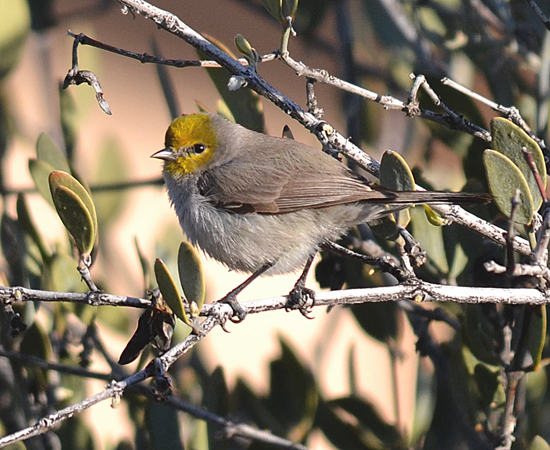
A Tiny Verdin
While I'm away in Chicago, here's a post from a recent trip to N. Scottsdale, Ariz:
This tiny little Verdin typically darts quickly amidst the desert sage plants and mesquite trees it is fond of. Its movements remind me of gnatcatchers. They're incredibly quick, continually darting around in shrubs, and their small size (only a little over 4"!) can make them somewhat difficult to photograph.
Found throughout the southwestern U.S. states and Mexico, the Verdin is the only North American member of the penduline-tit family (Remizidae), which are found throughout Eurasia and Africa. Most members of the family build incredibly complex hanging nests from spiderwebs, but the Verdin does not. It chooses instead to harvest thorny branches, readily available in its arid habitat, and builds a domed nest in a shrub.
And, it doesn't just build nests for breeding. It's one of the few birds that builds a roosting nest. Temperature ranges in the desert are extreme and the small roosting nests are well insulated to help the birds stay warm during the winter months.
The Verdin's beak is thinner than a typical tit's, and is used to pry bugs out of thin crevices in trees and flowers. Typical of other tits, the Verdin has a tendency to hunt upside down along tree limbs. Verdins also consume nectar. It'll visit hummingbird feeders and loves fresh-cut oranges. During the spring desert bloom, Verdins are often spotted sipping nectar from cactus flowers (I'd love to see that!).
The distinguishing russet shoulder patch isn't visible in this photo, but a good photo showing this can be found in a wonderful Sonoran birds post by Jeff Cooper.
Tuesday, March 5, 2013
Barred on My Birthday
A smash on my home office window made me cautiously peer out through the blinds. There, down below outside was Dean making a bunch of weird arm movements and pointing east. He'd thrown a snowball up to my window to get my attention.
After a few minutes of charades I realized he wasn't having spasms but was pointing to something in our ash trees.
The Barred Owl has returned and is actively hunting in our yard today. What an awesome birthday gift! The day just keeps getting better and better!
We've had the owl in our yard off and on since last summer when its strange calls (owls do more than hoot!) would send shivers down our spines late at night around the campfire.
A few months ago, it started showing up in our yard in the late evening and early morning, and within the last two weeks it has been roosting in our spruce trees and our big white pine:
Today's the first time I've seen it actually hunting in the middle of the day. We have plenty of prey around for it, with all our bird feeding stations (mice, voles, squirrels, rabbits) so it should be getting enough food. We're guessing it's a young owl who has just staked out its new territory. How lucky are we!
It seems to have learned we don't pose a threat to it, and in fact probably gives us props for chasing off the crows that mob it periodically. The crows will fly in and start a ruckus, the owl will twitch open its eyes, Dean heads out the door and yells at the crows, they leave and the owl goes back to sleep.
In today's snow the owl is nearly invisible once it's landed in our trees with its brown and white markings. The vision of it swooping low across the snowy yard is just stunning. Will have to try to snap an in-flight photo. Such a treat to watch an amazing bird...
Saturday, February 9, 2013
Thursday, January 17, 2013
Semipalmated Sandpipers (well, actually NOT)
One of the best parts (in my mind) of writing a blog is the education I've gained from researching what I'm writing about. Today, I learned that these birds, which I had ID'd as Semipalmated Sandpipers, are actually Sanderlings. A big thank-you to professional bird photographer Mia McPherson for pointing out an easy way to tell the difference when both birds are in their similar non-breeding plumage: The shape of the end of the bill (check out the photo below to see the heavier, bulbous end compared to a Semipalmated Sandpiper's narrow, finer bill).
So... here's my original post, edited to reflect the correct bird ID. Thanks again, Mia!
Some of my favorite birds to watch while we were out east in October were (NOT) the Semipalmated Sandpipers but rather Sanderlings. From the house we could look out at the shore and see all these bright white butts sticking up in the air. Then they'd scurry around and run back in toward the water line, butts once again up in the air as they dug out tasty snails and teeny crabs. (this is apparently a trait that Semipalmateds do not exhibit often, but Sanderlings are constantly scurrying back and forth)
Another easy way to tell the difference between Sanderlings and Semipalmated Sandpipers is that Semipalmated have a hind toe that is easily visible. These Sanderlings, as shown above, do not.
These birds were on their way from their breeding grounds in the arctic tundra and Hudson Bay, to their winter grounds in Central America and coastal areas all around South America.
Monday, January 14, 2013
Friday, January 11, 2013
Snowy Redpolls
The redpolls may be my favorite winter visitors. They're just so gregarious and dapper looking. The ones in these images are the more often-seen Common Redpoll.
During a recent snowfall I had fun snapping these photos through the kitchen window while staying nice and cozy inside.
These beautiful birds are irruptive and in years like this travel in large flocks farther south than normal. While we periodically have them in the Twin Cities, this is only the third winter since I moved here in 2002 that we've had 80+ redpolls at our Afton feeders on a regular basis.
An irruptive winter is not only a thrilling one, but an expensive one (we're going through 40 lbs. of Nyjer a week!). Unfortunately these birds at the cabin aren't quite as lucky - they go days without seed waiting our return for long weekends.
Typically, these birds are found worldwide in the arctic and subarctic boreal forests. In North America, they venture into the Northern United States during the winter and as far south as the Central United States in irruption years.
Because I'm in the process of obtaining my banding license, the recovery of bands fascinates me. On the Cornell Lab site, they listed this cool fact about banded redpolls:
"A few banding records have shown that some Common Redpolls are incredibly wide ranging. Among them, a bird banded in Michigan was recovered in Siberia; others in Alaska have been recovered in the eastern U.S., and a redpoll banded in Belgium was found 2 years later in China."
That's amazing!
Another cool fact that I learned on the Cornell site? They burrow into the snow to stay warm overnight! They've found them in tunnels a foot long.
Want to learn more about these neat winter visitors? Check out Cornell's site.
Tuesday, January 8, 2013
Diamonds on the Lake
The other day while ice fishing we noticed incredible frost crystallization around the prior day's holes and in our earlier footsteps. After we were done fishing, I came back out with my camera to try and capture the amazing brilliance of the crystals.
The sun was beginning to set over the lake and the entire area was spiky with diamonds. While it doesn't look like much here, it was breathtaking to see in person:
Up close, this is what was catching the sun, hundreds of gold frost "leaves:"
While incredibly small, they were some of the largest frost leaves I have seen, nearly .5" in length.
As the sun set, it really began to light up the crystals. I love this illuminated stack, looks a foreign creature glowing from within:
The most challenging part of photographing these? Not melting them with my breath while lying on the snow trying to focus on them! This is one of the better shots showing both the gold of the sunset and some of the incredible detail in the frost leaf:
Don't you love all the unexpected treats that winter brings?
(I'm thrilled to be back after taking a month off of nearly all electronics except as required for my work. It was lovely to spend the month of December with family and friends and at our cabin. I hope you had a fun end to 2012 and are having a great start to 2013. Thanks for reading my blog!)
Subscribe to:
Posts (Atom)