Our spring in Minnesota has been brutal for insectivores. Dozens of Eastern Bluebirds and Tree Swallows have been found dead in nestboxes, having starved (or frozen?) to death during our cold, wet spring. Phoebes, which showed up more than a month ago, have been completely absent since our late snows and freezing temps. It's hard to survive when your primary food source isn't available.
In the last two weeks there have been days on end of "warbler fallouts" where they're basically littering the ground, searching for any morsel to eat. And any hint of sunshine brings the warblers out in full force, hunting for any bugs they can find. While it makes for great birding, it's sad to know that it's because they're struggling to survive.
On Sunday, we had this very curious Chestnut-sided Warbler follow us through the gardens. Can you ask for a more beautiful bird to stalk you? I think not.
He started flitting down to us as we were poking around in the wood chips searching for signs of emerging ferns and lupines. I imagine we were uncovering tasty morsels for him.
From there, he followed us to our "East Garden." As Dean looked over the plants that have emerged in that bed, the warbler flitted down right next to his feet and hopped from the garden up to a rock and back down again. It was amazing to have this gorgeous bird so close for so long.
It's been here for several days now, enjoying suet with the dozens of Yellow-rumpeds. As a special treat I picked up 1,000 mealworms on Monday for everyone. They were gone in a matter of hours much to the delight of the birds (and me who enjoyed watching them eagerly slurp them down like spaghetti noodles).
I included this photo because it shows the beautiful markings on the Chestnut-sided's back. I never realized how much yellow they have on their backs until this weekend:
After all our cold weather (there was frost on Sunday night) we hit a whopping 96 degrees today. Many of the warblers in our yard took advantage of the warm weather and moved on. I didn't see the Chestnut-sided at all today and there are only a couple dozen Yellow-rumpeds still hanging around.
Can't wait to see what the warm weather and high winds blows in overnight! Stay tuned...
Posted in conjunction with other bird aficionados through Wild Bird Wednesday. Be sure to check them all out!
Showing posts with label songbird. Show all posts
Tuesday, May 14, 2013
Saturday, May 11, 2013
Surprise Visitor: Western Tanager
As I peered out my front window Wednesday morning, all bleary-eyed and not yet awake, I was surprised to see an overly large goldfinch. Since my brain wasn't fully awake yet, this is the conversation that I had with myself:
"That's not a goldfinch, too big... female oriole? Huh, what's wrong with it's head? No, not an oriole... Good grief, did someone's parakeet escape? What the heck? Oh my gosh: It's a Western Tanager."
Long silent pause as I soaked in the joy of seeing one of these birds. IN MY YARD.
Springing things like this on me first thing in the morning before my synapses are all firing isn't the best idea, but let me tell you. It sure woke me up!
I'd left my camera in the car overnight and all I had was the truly crappy camera on my Droid (why, oh why, can't we get good cameras on Droids?). So I snapped a few pictures just for documentation while I quietly swore to myself to never, ever leave the camera in the car again.
Thankfully, the bird hung around and I was able to scamper to the car, get my camera and snap photos of it before I left for work:
And no. We don't have Western Tanagers in Minnesota. Although we do get enough of them through periodically - especially in the spring - that they're an infrequent visitor. The only other sighting of a W. Tanager in my county was in 1984 in Stillwater, Minn. Pretty exciting!
"That's not a goldfinch, too big... female oriole? Huh, what's wrong with it's head? No, not an oriole... Good grief, did someone's parakeet escape? What the heck? Oh my gosh: It's a Western Tanager."
Long silent pause as I soaked in the joy of seeing one of these birds. IN MY YARD.
Springing things like this on me first thing in the morning before my synapses are all firing isn't the best idea, but let me tell you. It sure woke me up!
I'd left my camera in the car overnight and all I had was the truly crappy camera on my Droid (why, oh why, can't we get good cameras on Droids?). So I snapped a few pictures just for documentation while I quietly swore to myself to never, ever leave the camera in the car again.
Thankfully, the bird hung around and I was able to scamper to the car, get my camera and snap photos of it before I left for work:
And no. We don't have Western Tanagers in Minnesota. Although we do get enough of them through periodically - especially in the spring - that they're an infrequent visitor. The only other sighting of a W. Tanager in my county was in 1984 in Stillwater, Minn. Pretty exciting!
Wednesday, April 24, 2013
Spring Air Brings First Warblers!
Yesterday, amidst the 6" of freshly fallen spring snow, a dozen or so Yellow-rumped (Myrtle) Warblers flitted around our yard from suet feeder to suet feeder. The males are in their gorgeous breeding plumage: Deep blues and greys with bright yellow splashes on their heads, chest and on their butts (hence the casual term "butterbutt").
The females (below) are more drab, but still a beautifully-marked bird. And, perhaps more importantly: A very welcome reminder that warbler migration is actually underway and we'll be seeing more species over the next few weeks. It's been a long, long winter!
At first glance, the females might appear brown or grey, but they have bluish streaks throughout the feathers (visible in the above photo). They're really a beautiful mix of colors.
In addition to our suet feeders, they're feasting on peanuts. Both Yellow-rumped Warblers and Pine Warblers have a wider diet than many other warblers, allowing them to be some of the earliest returning migrants.
And, for my international viewers joining in on Wild Bird Wednesday, the Amer. Ornithologists' Union (AOU) has not followed the IOC (International Ornithological Congress) in re-splitting the four "yellow-rumped" warblers into individual species. Here in The States, we still have the "Myrtle" in the eastern half and the "Audubon" west of the Rockies.
Wednesday, April 17, 2013
Snowy Fox Sparrows
Yes, I said "snowy." For most of the Midwest it's been a really LONG winter. I've been watching fellow bloggers post images of butterflies and moths, blooming flowers and migrating warblers. Keep it up, please - you're helping me keep the winter blues away!
Another thing that helps with long winters like this, is the opportunity to observe migratory birds a bit longer as they hunker down to wait out the weather.
In addition to the hordes of juncos currently mobbing our feeders, we've had a large flock (20+ birds) of Fox Sparrows hanging around.
Fox Sparrows are "scratchers." They scratch back on the ground, giving a short hop as they do it, to uncover and loosen seeds. It's been really fun to watch them do this in 4-5" of snow. They scratch. Look down at the snow. Scratch again. Nope, still snow. Keep scratching!
We've been distributing bird seed all around the yard under our spruces and pines, giving the birds some cover while they forage. Two days ago there were hundreds of robins hanging out under the trees, escaping the icy rain.
But getting back to the beautifully-marked Fox Sparrow... I think they look like a cross between a thrush and a sparrow. The russet tail and the large splotchy neck and chest remind me of a Hermit Thrush. And the way the splotchy pattern runs down their sides reminds me of Ovenbirds. Size-wise, they're one of the largest sparrows, half again as big as a House Sparrow but not quite as large as the Harris's Sparrow.
And, while this isn't a very good photo, I'm going to include it simply because it's an opportunity to see its crest. Most people don't realize that Fox Sparrows have a small crest similar to Tree Sparrows:
It's also a chance to see the slate gray coloration on the sparrow's nape and sides of its head. Western Fox Sparrows have more gray with very little russet color.
Most of these beautiful birds will be gone in the next week or so, continuing their migration from the southern U.S. to upper parts of Canada and Alaska. Flocks of the western Fox Sparrow breed throughout the Rocky Mountains as well.
One of the best parts of having these large sparrows around? They have a beautiful song! I've been cracking my kitchen window open just to enjoy their songs. Larkwire has a nice recording.
Well, I'm off to enjoy other more tropical bird posts, all part of Wild Bird Wednesday. Be sure to visit the other bloggers to see what they've been up to!
Friday, March 8, 2013
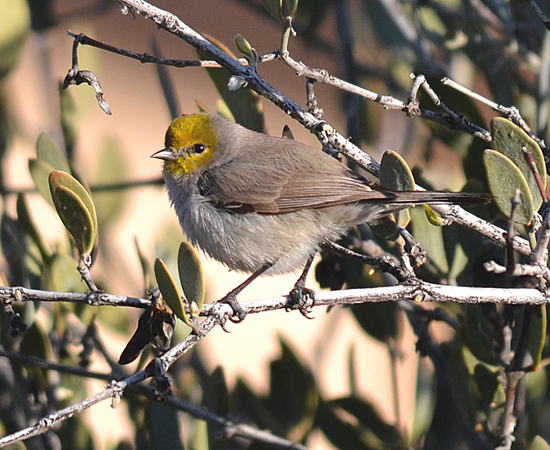
A Tiny Verdin
While I'm away in Chicago, here's a post from a recent trip to N. Scottsdale, Ariz:
This tiny little Verdin typically darts quickly amidst the desert sage plants and mesquite trees it is fond of. Its movements remind me of gnatcatchers. They're incredibly quick, continually darting around in shrubs, and their small size (only a little over 4"!) can make them somewhat difficult to photograph.
Found throughout the southwestern U.S. states and Mexico, the Verdin is the only North American member of the penduline-tit family (Remizidae), which are found throughout Eurasia and Africa. Most members of the family build incredibly complex hanging nests from spiderwebs, but the Verdin does not. It chooses instead to harvest thorny branches, readily available in its arid habitat, and builds a domed nest in a shrub.
And, it doesn't just build nests for breeding. It's one of the few birds that builds a roosting nest. Temperature ranges in the desert are extreme and the small roosting nests are well insulated to help the birds stay warm during the winter months.
The Verdin's beak is thinner than a typical tit's, and is used to pry bugs out of thin crevices in trees and flowers. Typical of other tits, the Verdin has a tendency to hunt upside down along tree limbs. Verdins also consume nectar. It'll visit hummingbird feeders and loves fresh-cut oranges. During the spring desert bloom, Verdins are often spotted sipping nectar from cactus flowers (I'd love to see that!).
The distinguishing russet shoulder patch isn't visible in this photo, but a good photo showing this can be found in a wonderful Sonoran birds post by Jeff Cooper.
Subscribe to:
Posts (Atom)