Follow _CabinGirl on Twitter

Tuesday, March 27, 2012

Spring Flower Phenology, Of A Sort


I returned home from Chicago to find the Pasqueflower open, the forsythia leafed out and tulips budded.

Seems amazingly early to me, but I thought I should dig through all my phenologies to confirm. I've kept a record since 2002 for our house outside the Twin Cities.

I learned a few things doing this:
1) I'm not as good as keeping records as a I thought. For example, in my mind I always note the opening of the pasqueflower as the sure sign of spring. Turns out that I've actually only recorded it for THREE years, including this year. How'd that happen?
2) I've sadly lost (hopefully just misplaced) my records for '04-'06.
3) Phenologies confirmed the association in my mind of pasqueflower and forsythia opening around the same time.
4) I do keep lots of information in the phenologies, but it's not always consistent by species. (some years I may not have noted arrival of bluebirds, or of first baby wrens but did not first wild plum blossoms or first fall frost)

Here's what I do have:
Pasqueflower Opened
2002: April 14 also the 1st 70+ day of that year
2011: April 24 (here's a link to more info on the pasqueflower from my 2011 post)

Here's some detail on the pasqueflower. I love the silky hairs on the petals and the silvery pollen inside.


Forsythia Opened
2002: April 17
2003: April 14, also record high of 89 today
2007: Cold killed forsythia blooms before they opened on April 9
2009: April 17 Of note, released first Pine Siskin fledgling we'd ever had from WRC today
2011: April 24
2012: March 20 (fully opened)

If you don't keep a phenology of your yard I highly recommend it. It's fun to go back and see when the first hummingbirds arrived, or what year it was that you had Scarlet Tanagers in your yard. Or your first bluebird nesting pair. I use it for everything from noting the habits of wildlife, to when I seed and harvest the first greens, tomatoes and other garden veggies.

For my purposes, an appointment-style nature calendar works the best (for 2011 it's one of our local Weatherguide Calendars). Plenty of room to note things and usually there's a timely photo on the left-facing page. Not only that, but they store easily.

Now I just have to remember to write in them more often!

Sunday, March 18, 2012

Chasing March Butterflies

Last year at this time we had several feet of snow on the ground and were worried about flooding in the St. Croix River Valley.

This year, it's March 18th and I'm out chasing butterflies in 80 degree weather.

The warm weather has stymied the maple sap run throughout most of the Upper Midwest, and what little sap is seeping from the trees attracts dozens of insects, including the first butterflies of the year.

At first I thought there was just one species, but after much patience with the camera, it looks like there may be three, all of which hibernate as adults. (and, since I'm doing all this ID using my "Golden Guide on Butterflies and Moths," please let me know if I've mis-ID'd something!)

The first one I spotted was the Comma:


Here's the silhouette of a Comma drinking sap from the maple:


This one I immediately noticed was different because of the light edging on the wings:


Here's a side view that shows the dark texture of the wings:

 
 Then it opened. It's a Mourning Cloak:


Thought I'd try to get a better shot of the Comma and realized that this butterfly was not a Comma. Turns out it's a Compton Tortoise Shell:


Here's the underside of the Compton's wings:


This one just makes me smile:


Can't think of a better way to spend a March day! Might have to check the trees out tonight to see if moths visit...

Friday, March 9, 2012

Fox Sparrow Visits With Redpolls


It's not the greatest photo since the birds were out in the yard (and I desperately need a new lens), but I had to snap it. Not often you see a Fox Sparrow with redpolls.

Fox Sparrows do periodically overwinter here in the Cities, but it's still a fun sight to see on a bright sunny Friday with promises of springlike weather around the corner. This one did not overwinter in our yard. New arrival or an overwintering bird? Guessing it overwintered nearby but it still amps up my excitement for spring migration!

Monday, March 5, 2012

A Bright Spot for Monday


Looking out my kitchen window this morning was thrilled to see a significantly yellower goldfinch on one of our feeders.

With warmer temps coming and singing birds it sure feels like spring is here!

Monday, February 13, 2012

Northern Flicker and Downy


I always forget how large Northern Flickers are (wingspan of 17-20") until I see them with other birds. Here's a yellow-shafted one with a male Downy Woodpecker.

While we have flickers around our yard in the summer, I tend to think of them more as a winter visitor. For the past four or five years we've had a pair in the yard all winter, using the heated baths and coming to our suet feeders. During the summer, natural food and water sources are abundant so we don't see them daily like we do in the winter. Maybe it's the same pair, just forced closer to the house due to diminished food supplies...

Fun fact: Flickers are the only ground-feeding woodpecker in North America!

Saturday, February 4, 2012

Frost and Finches


Last night's drop in temperature brought a gorgeous frosty morning here in the St. Croix Valley. Even the barbed wire is frosted. All the spikes face north on the frost, reflecting a northern wind as the frost was forming. The south side of everything is frost-free.


I thought this was hoarfrost, as rime ice typically only forms in moist areas, but after more research, I think it is actually rime ice as it formed in the foggy conditions last night while the temperature dropped. From what I understand, hoarfrost is formed without fog moisture and usually is more feathery instead of spiked. It's softness arises from condensation, whereas the spikes of rime ice come from deposition.

Would appreciate learning more from any of you who are familiar with the two processes!

I love the silhouette of the frost and finch:

Saturday, January 28, 2012

Sharp-shinned Hawk

Nature's alarm system (Blue Jays and chickadees) alerted me to something in the yard a few minutes ago. Looked out the window and sure enough, sitting right on top of one of the feeder stations was this gorgeous immature Sharp-shinned Hawk:


Saturday, January 21, 2012

Appreciating A Black Squirrel


We're up at the cabin in Lakeshore (for the now-cancelled ice fishing extravaganza) and are enjoying watching the resident black squirrel. We've discovered she's a female. Yep, believe it or not it's mating season in the frozen northland. Eastern Gray Squirrels, which is what this black squirrel is, have their babies in late February or early March; a 44 day gestation period.

If you're a blogger and have a squirrel story, share it via Pintrest or Twitter (#squirrelday). Here are more ways to share your squirreliness.

For more information on black squirrels, here's my post from a year ago.

Friday, January 20, 2012

Favorite Finch Feeder

I worked with a wild bird store for years and always loved hearing what feeders people use in their yards. A network of other bird lovers is the best way to find new ideas on how to attract birds to our yards.

So, I thought I'd share my favorite Nyjer seed feeder with all of you: a heavy duty, stainless steel model from Birds Choice.


During irruption years like this, every inch of the feeder has some species of finch clinging to it. Even the chickadees change up their diet every now and then by coming to it. During the summer it's filled with goldfinches and the occasional Indigo Bunting that's brave enough to cling to the feeder instead of perching on the Nyjer tube feeders we have in our yard.

I've never had the seed mildew in the feeder (they empty it too fast!), but I think in damp areas (like the Pacific Northwest) that could be an issue.

And no, I don't receive anything for posting this - just hoping to share ideas with fellow bird lovers!

Tuesday, January 10, 2012

Muskrat Susie, Muskrat Sam...


During a recent trip to the cabin we enjoyed watching a muskrat take advantage of nice weather and thin ice. It spent most of every daylight hour going up and down out of two ice holes, pulling up long strands of weeds and what looked like lily pad roots.

Muskrats do not hibernate, but they're usually not this visible at this point in the winter either. They spend most of the winter in their lodge (those large rounded mounds you see out in lakes) sleeping and eating.

They're still trapped for their fur, but even without the threat of traps, muskrats lead very short lives (one year is common, two or three years is rare). They make up for this by having as many as four litters a year though, starting in early March.

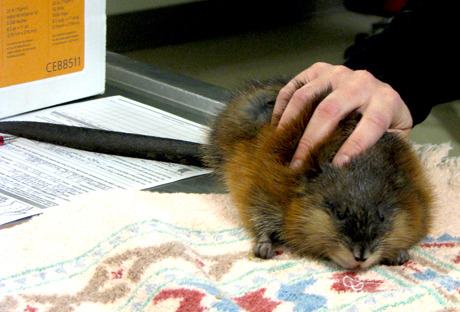
Here's a close-up of a muskrat at WRC for those who haven't seen one before. They essentially look like a small beaver with a long, naked tail (and don't worry, her other hand is gloved - they have very sharp teeth!):


And, just because it wouldn't be right to leave this out, here's the link to Muskrat Love. Enjoy!

Monday, December 19, 2011

Pine Grosbeaks

Nothing empties a sunflower feeder faster than a flock of grosbeaks. (here's a video on YouTube showing why.)

Pine Grosbeaks are a bit smaller than jays but for their size have an incredibly soft whistling voice. It always amazes me that these large birds make such a soft sound.

In fact, overall they just seem like a "soft" bird. Even with their sharp, bright markings, they have a plump look to them due to the thin grey edging on the feathers and their large chests. They are incredibly graceful fliers and land much more gently than even the tiny chickadees. And, while initially timid, they quickly grow accustomed to us and don't mind being at the feeder while we fill ones nearby.

Males are bright red, and since we don't have cardinals in Hovland, they're the brightest bird at the feeder at this time of year. Females are a dusky gray with a wash that varies from orange to yellow in the sunlight. Immature males look nearly identical to females, maybe a tad bit more red to their orange coloration. They don't develop their bright red color until their second year:

They're with us for nearly nine months every year, flying north for the short summer breeding season. And, while they're regular winter visitors, they are classified as an "irruptive" species meaning that there are some years of mass migrations south. We've never had more than 30 in the yard; I can't imagine how beautiful an irruptive year must be!

Friday, December 16, 2011

Stiff Club Moss


A forest of miniature pines pokes its way through the snow covered bog. These tiny evergreens are stiff club moss (Lycopodium annotinum) one of several club mosses native to boreal forests.

A favorite treat for moose, stiff club moss was used by Native Americans to aid clotting and the highly flammable spores were an ingredient in the original flash powder used by early photographers.

The stiff club moss spreads through surface rhizomes, but also produces spores on the top (as opposed to the shiny club moss that looks similar but has spores on the sides of the plant). Cool fact: not only are the spores highly flammable, they are water repellent. Brush your finger through a bunch of stiff club moss spores and dip it in water: your finger is completely dry!


All club mosses are highly fragile and don't transplant easily or survive heavy foot traffic. They are found throughout much of the U.S. and northern Europe, and often grow in white or black spruce forests along with cloudberry, mooseberry and twinflower. (US Forest Service)


Sunday, December 4, 2011

Ice Circles


Winter crop circles? Signs of alien life? Nope, just tiny ruptures along a lead in the ice. When the water slowly swells through them, it distributes at an equal distance from the fracture point (as long as there are no obstructions), forming perfect circles on the early ice. (Brainerd, Minn.)


Snowy Seed Heads


Last night's gentle snowfall left a wonderland for exploration this morning. With no wind, the snow formed amazing sculptures on the tiniest of platforms: seed heads.

Wild Columbine:


Coneflower:


Rosehip:


 This meadow weed left behind a tiny knotted seed head, size of my pinkie nail:


And, a natural santa's cap on a coneflower: